


“Do you consider yourself lucky?”
This was, by far, my favorite interview question I’ve ever been asked. It’s deceptively simple, but it reveals a great deal. Is the candidate optimistic or pessimistic? Do they appreciate the role others (and even the universe) have played in their lives, or do they believe everything is a result of their individual effort?
I said yes then, and I suspect that was a big reason I got the job. Sometimes, we get lucky.
But luck is a fickle strategy.
This is my first post in a while because my luck recently ran out. First, I threw my back out. Then, my one-year-old son needed surgery on both of his legs. Thankfully, both of us are on the mend.
This forced pause gave me time to reflect. Luck gets you in the door, but systems keep you there.
If you're new here, this post is your map. If you've been here since January, it's a reminder of how far we've come.
New to CFO Frameworks? Start Here
If you joined recently: Welcome. We started with 10 readers in January. Most of you joined in the last quarter, which means you’ve got a year’s worth of frameworks waiting in the archive. Consider this your orientation.
Three posts to start with:
Wait for It - How to speak up when it matters, and shut up when it doesn’t.
The ABCs of Partnership - How to get off the sidelines and into ever decisive huddle.
Less is More - How to add by subtraction.
Been here from the beginning? You know where we’ve been. Skip ahead to What’s Next to help shape where we’re going.
What I Learned by Writing This Newsletter
Early in my career, I thought finance leadership was about being right. Build the perfect model, present the data, and watch people comply. I was…insufferable.
I wasn’t a leader; I was a barrier. The “Dr. No” who killed momentum. The analyst who presented data like a stampeding elephant without regard for the story. I realized that while our education teaches us how to build the model, it rarely teaches us how to get people to listen to it.
Writing this newsletter forced me to articulate what I’d learned the hard way: nobody cares about your model if they don’t understand the story. Nobody implements your recommendation if they don’t trust the relationship. Excellence in finance is 20% technical, 80% behavioral.
That insight became FRAME—Focus, Relationships, Analysis, Messaging, and Execution. It’s not a methodology. It’s a mental model for how effective finance leaders actually operate.
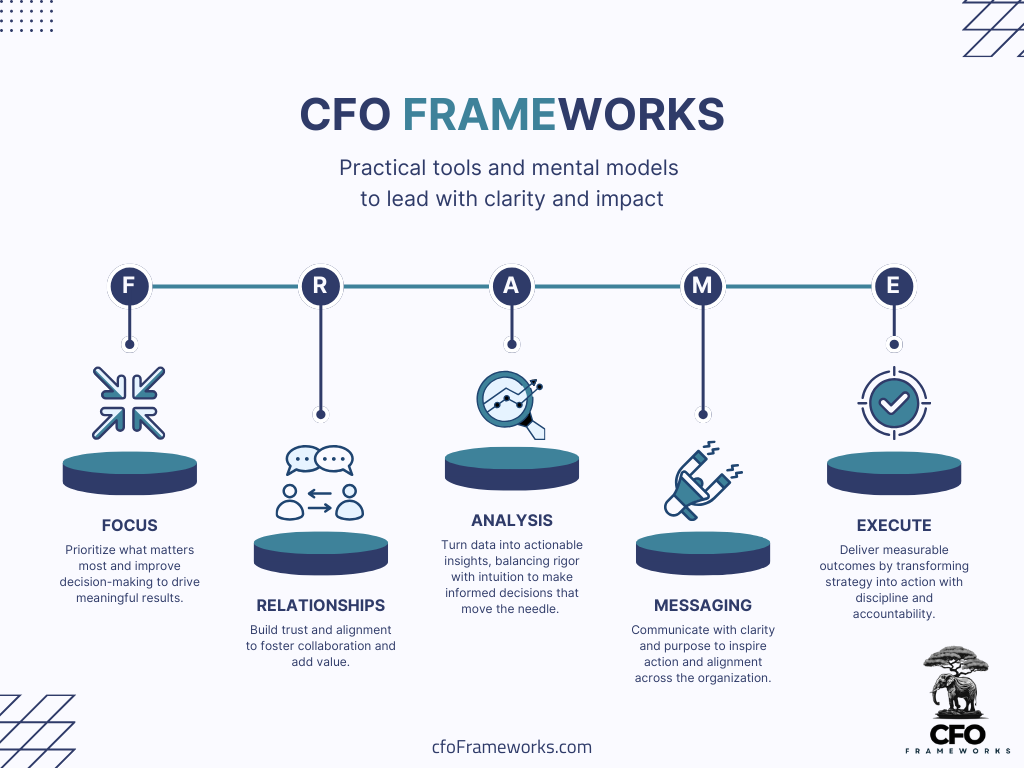
Over the past year, we’ve built a library of tactics using this structure. Here’s your guide to what matters most.
The FRAME Library: Your Guide to the Archive
F — Focus (Prioritization)
The core problem: We waste time on trivial decisions while avoiding strategic ones. Urgency masquerades as importance, and even great teams drift off course.
Start here if you’re new:
Break Free from the Bike Shed - Why we obsess over $28 lunch charges instead of $28M strategic decisions, and how to apply the Law of Triviality to reclaim your focus
Gravity Wells - The prioritization frameworks that help anchor teams to core priorities before the day begins, with a toolkit for diagnosing what’s pulling you off course
The practical takeaway: Before your next meeting, ask “Is this a bike shed?” If you’re spending energy disproportionate to the decision’s impact, you’ve found one. Name it, then redirect.
R — Relationships (Influence)
The core problem: We think our job is to be the brake pedal, but our real job is to build the business up, not break people down. We try to be the hero who fixes everything, creating teams that depend on us rather than own their outcomes.
Start here if you’re new:
No More Dr. No - How to use “Yes, And” to validate goals while pivoting to trade-offs, transforming from blocker to strategic partner
A Light Touch - How to gauge Task-Relevant Maturity so you know when to be hands-on and when to step back and let your team own the outcome
The practical takeaway: Next time someone asks for more budget, resist the immediate “no.” Try: “Yes, that sounds like an important initiative... and we’ll need to figure out what to cut to fund it. Let’s talk through the trade-offs together.”
A — Analysis (Data & Insight)
The core problem: We rely on “System 1” thinking - fast, intuitive - which gives us an illusion of understanding. We design for the “average” and end up serving no one.
Start here if you’re new:
Confident... and Completely Wrong - How to develop Story Sense: when an explanation feels too complete, pause and think “maybe”
One Size Fails All - Why designing for the average (like the 1950s Air Force cockpit) ensures you fit no one, and why you need to disaggregate your data to find excellence in the edges
The practical takeaway: Next time you see an average that “tells the story,” dig one level deeper. Break it down by segment, cohort, or time period. The most important insights are usually hiding in the variation.
M — Messaging (Communication)
The core problem: We present raw data to the “Rider” (logic) but ignore the “Elephant” (emotion). We use vague terms like “innovation” or “strategy” that mean different things to everyone - Black Hole Words - that guarantee misalignment.
Start here if you’re new:
The Numbers Will Speak for Themselves (They Won’t) - How to use the STORY framework (Set the stage, Treasure/Obstacle, Resolution) to bridge the gap between analysis and action
The Montoya Matrix - How to convert Black Hole Words into Binding Words with precise, measurable definitions that align teams
The practical takeaway: Before your next presentation, write down your key message as a story: What’s at stake (Set the stage)? What opportunity or problem exists (Treasure/Obstacle)? What are we going to do about it (Resolution)? Build your slides around that narrative.
E — Execution (Operations)
The core problem: Every short-term workaround acts like a credit card swipe against your future agility—what I call Decision Debt. And urgency without autonomy creates chaos, not speed.
Start here if you’re new:
Decision Debt: The Hidden Cost of Every (In)Action - How to SCAN your environment to identify “Invisible Drift” and standardize before the debt compounds
Fast is Fragile - How to build Smooth Operators by giving them the “envelope” (the mission) instead of just the task list
The practical takeaway: Identify one workaround your team has been living with for more than 90 days. That’s Decision Debt. This week, either standardize it (make it official) or eliminate it (stop the bleeding).
What’s Next?: The Psychology of Finance
We started with 10 readers. Within a year, we crossed 200. Over 150 of you joined in the last eight months.
That growth means I’m hearing new questions - less about “how do I build the model” and more about “how do I get people to listen to it.” Less technical, more human.
That’s leading me into Year Two’s focus: The Psychology of Finance. The behavioral dynamics that separate good finance leaders from great ones.
I’m currently researching three deep dives for January. If one of these hits close to home, hit reply and let me know—I’d love to prioritize what helps you most:
Meeting Fatigue - Why most meetings suck, how to fix yours, and when to just decline the invite altogether.
Hills to Die On - How to pick which conflicts actually matter and how to navigate them without burning bridges or your reputation.
Ambition vs. Burnout - How to be strategic about your career trajectory instead of just grinding harder and hoping for the best.
Your input directly shapes what I write. If there’s a different “soft skill” struggle keeping you up at night, I want to hear about it.
Before You Go
If you’re reading this, you’re either part of the early crew who took a chance on an unknown newsletter or you’re new, and someone you trust sent this your way. Either way, thank you. This only works if it’s useful.
If you found value in this post, the best way to support this work is to share it with someone who’s dealing with the same challenges. Send them the post, or just send them to cfoframeworks.com to subscribe.
Here’s to Year Two, and to building systems that outlast our luck.