The trouble started shortly after I bought my truck.
To give my wife extra space in the driveway, I parked slightly off to the side. Within a week, a small pool of water appeared beneath my tire. My stepdad - the kind of guy who once disassembled a microwave just to prove it could be done - took one look and said it was a damaged main water line. Standard residential pipes run about a foot deep in a straight line up to the house. We needed to dig on the left side of the meter.
One problem: the water was pooling six feet to the right.

Dig where the pipe should be, he said. You won’t find anything by the driveway.
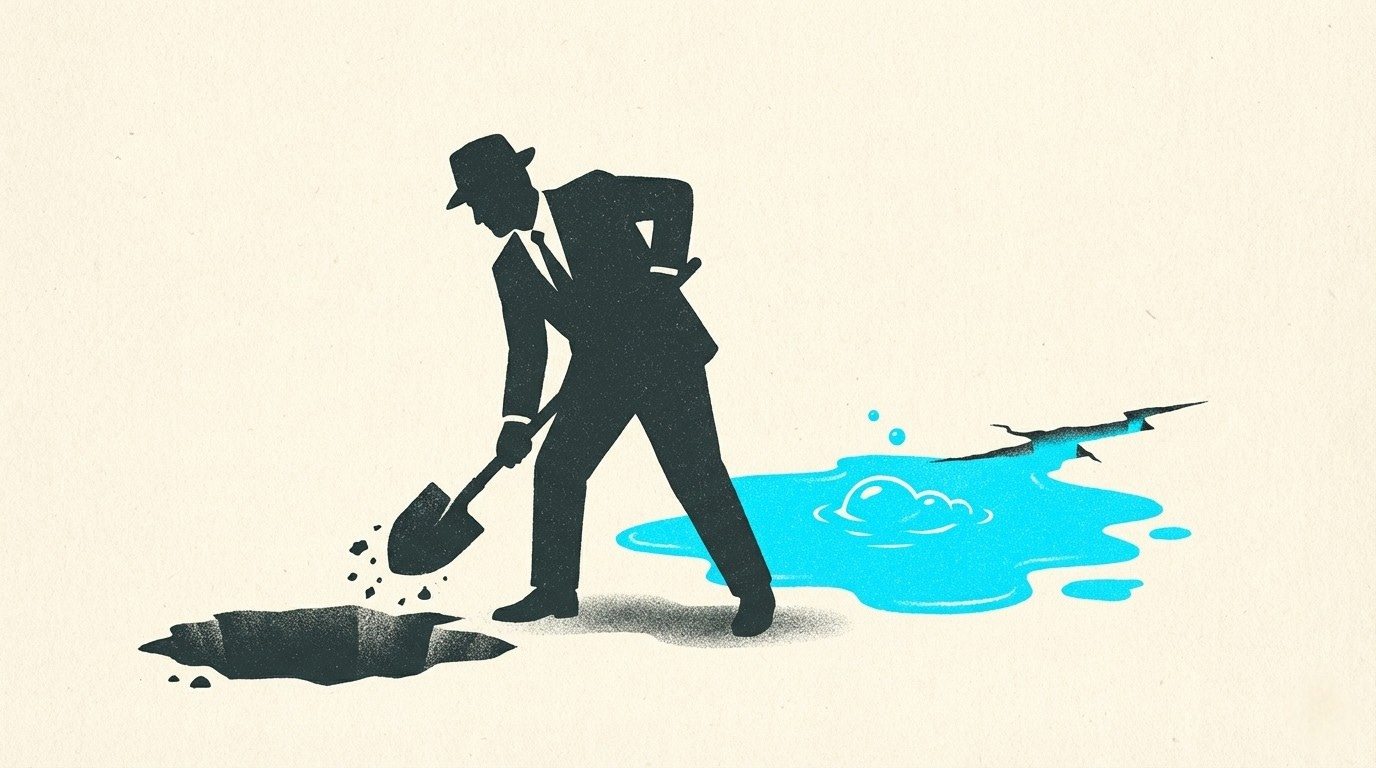
An hour in the brutal Arizona August heat and a three-foot hole later: nothing but dirt. My wife, watching from the garage, suggested I dig where the water actually was. I explained - patiently (condescendingly) - why that made no sense.
I eventually relented, just to prove her wrong.
Less than five minutes in: water line.
A corner-cutting installer had swapped copper for cheap PVC, routed it around the meter to hide the switch, and buried it so shallow that my truck cracked it in the first week. My stepdad’s expertise described a world where the contractor had done his job honestly. It had no answer for the one where he hadn’t.
I stood there, soaked, three feet deep in the wrong hole, looking at my wife standing over the right one. That gap between where I was sure the problem was and where it actually was has stayed with me longer than any leak.
Sometimes, our inability to plug a leak stems from our confidence in where the pipe should be.
Hidden Pipes
Revenue doesn’t just appear. It flows through a system of pipes you’ve built, inherited, or duct-taped together over time. When performance breaks down, the leak is always somewhere in that flow: pipeline, conversion, retention, pricing, etc.
The challenge isn’t that we ignore leaks. It’s that we look for them in the places our experience says they should be. Even if we’re aware of the existence of corner-cutting contractors, we don’t account for that existence if we haven’t personally experienced it.
The most dangerous blind spots are the ones your expertise has built for you.
Two Ways to Miss
I once watched a business unit work through a stretch of declining website performance.
Week after week, the finance lead pointed at the same culprit: a recent rebrand. He had a chart showing the traffic drop lined up perfectly with the new site launch. The data was clear. The timing was obvious.
The COO kept shutting it down. “Stop talking about the rebrand. It’s not the rebrand.”
The COO had led the rebranding effort himself. He’d followed best practices, done everything right, and his confidence in having done everything right left no room for what the data was plainly showing. Traffic drops after a website redesign are well-documented - common enough that entire SEO playbooks exist for managing them. He wasn’t unfamiliar with the concept, but his confidence in the team’s execution had ruled it out as a risk.
That’s one way to miss. You won’t look at where the water is.
But the finance lead had his own problem. He found the pool of water…and then he kept pointing at it. Week after week. Meeting after meeting. “It’s the rebrand” became a recurring agenda item, each time with an updated chart that showed what the previous one had already shown, as if re-proving the diagnosis was the same thing as making progress.
How much of the decline was attributable to the rebrand versus other factors? What was the expected recovery timeline as rankings stabilized? What levers could they pull in the meantime? He hadn’t touched any of these. He’d found the leak and was standing over it, pointing, waiting for someone else to pick up a shovel.
That’s the second way to miss. You find the water, but you refuse to dig.
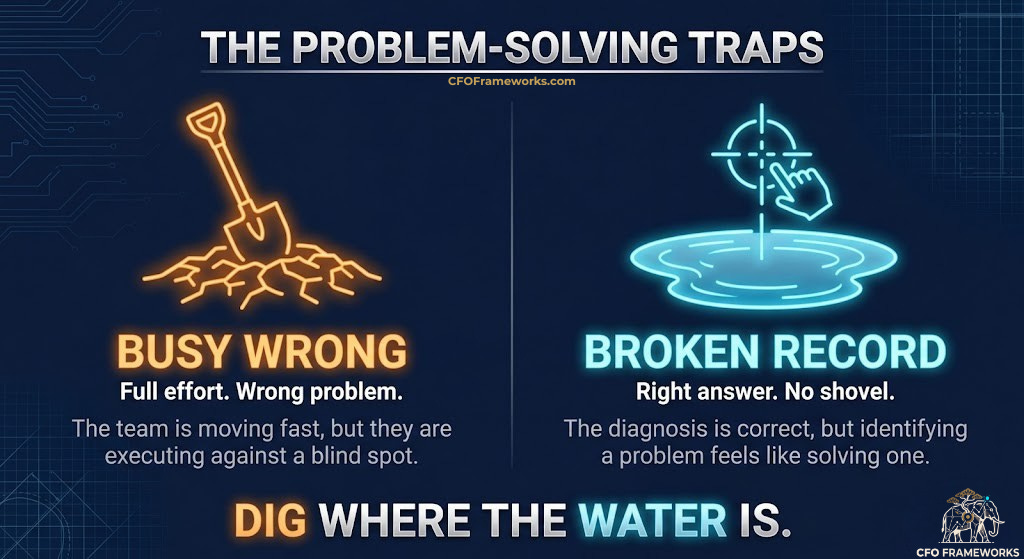
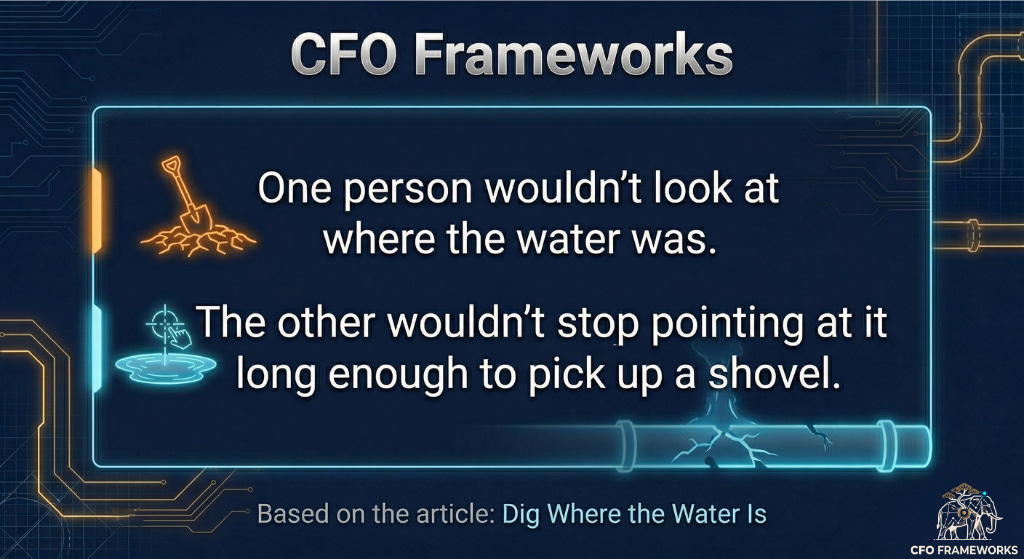
One person wouldn’t look at where the water was. The other wouldn’t stop pointing at it long enough to pick up a shovel. Both failures felt productive. Neither one fixed the leak.
In most organizations, when a team is stuck on a problem, they’re stuck in one of these two ways.
Busy Wrong
Full effort. Wrong problem.
This is the more dangerous of the two traps, because it’s the one that feels the most like progress.
The team has identified a problem and is executing against it with real energy. Shovels are moving. Dirt is flying. Meetings have action items. Dashboards are being tracked. The only issue is that the pipe is somewhere else entirely.
Me digging a three-foot hole on the wrong side of the meter was Busy Wrong. My stepdad had a clear diagnosis, a clear action plan, and total conviction in both. The problem wasn’t effort or commitment. It was that his expertise had pointed him to where the pipe should have been rather than where it actually was.
This plays out constantly. A sales team underperforms for two quarters in a row. Leadership reviews recent deal closures and lands on a diagnosis: a lack of discounting discipline.
Junior reps giving away margin, sloppy deal economics. The data support it. Everyone in the room has seen this movie. So the team launches a crackdown: new approval workflows, pricing guardrails, weekly deal desk reviews.
But if pipeline coverage is running at 2x when it should be 4x, the real problem is volume, not rate. Even perfect discounting discipline doesn’t close deals that aren’t in the funnel. The team has spent a quarter building infrastructure around the wrong problem while the actual crack - a collapsing top of funnel - continues to expand.
Undisciplined discounting is real. But it’s a drip. Insufficient pipeline is the leak.
This is the operational cousin of what I explored in Confident… and Completely Wrong: the gap between how sure we feel and how sure we should be. In that piece, the risk was analytical - fast thinking that skips the slow work of questioning our own conclusions. Busy Wrong is what happens when that same overconfidence gets operationalized. You don’t just think you know where the pipe is. You’ve deployed a team to go dig there.
The way out of Busy Wrong is a single question, asked before you commit more resources: if we fixed this completely tomorrow, would the number that matters actually move?
If the answer is clearly yes, you’re not Busy Wrong. Keep digging.
If the answer is uncertain, stop. Go back to the diagnosis. The instinct will be to keep executing because pausing feels like losing momentum. It’s not. A week spent verifying your diagnosis is almost always cheaper than a quarter spent solving the wrong problem.
The hardest part of escaping Busy Wrong is that it requires someone in the room to slow down a team that feels productive. Nobody wants to be the person who says, “I think we’re digging in the wrong place” when everyone else is breaking a sweat putting in effort. But that’s exactly the moment the question earns its keep.
Broken Record
Right answer. No shovel.
If Busy Wrong is dangerous because it mimics progress, Broken Record is insidious because it mimics contribution.
The team has the correct diagnosis. Sometimes painfully, obviously correct. And they keep re-presenting it because identifying a problem feels like solving one. The finding gets escalated, re-shared, and updated with fresh data that confirms what the old data already showed. Meanwhile, the actual lever sits unassigned, and the pipe keeps leaking.
The finance lead in the rebrand story was a Broken Record. He was right. He was right every single week. And being right, week after week, didn’t recover a single dollar of lost traffic.
Broken Record persists for a specific reason: the person who finds the leak usually isn’t the person who owns the lever. The finance team can identify the traffic decline, but the fix lives in marketing or product. So the finding gets re-presented, because re-presenting it is the only move available to the person holding the data. Each repetition is an implicit plea - will somebody please do something about this? - disguised as an update.
And every week, the finding gets re-presented without a plan attached, and the cost compounds. I’ve written before about Decision Debt as the hidden cost of deferred action. Broken Record is one of the most common ways organizations accumulate it. The diagnosis exists. The lever doesn’t. And each week of inaction both delays the fix and, more importantly, narrows the options available for fixing it.
The way out of Broken Record behavior is to convert the diagnosis into a decision. Before the finding gets presented one more time, it needs three things:
A number. Quantified revenue or cash impact. Not directional. Not “material.” A number.
A horizon. How long until this drains the well? Weeks? Quarters? The time horizon changes everything about urgency.
A lever with a name next to it. Not a workstream. Not a taskforce. A specific action and a person who owns it.
Without a number, horizon, or lever, you haven’t picked up the shovel yet. You’re simply pointing.
The finance lead had the data. What he didn’t have was a story that translated “here’s what’s broken” into “here’s what it’s costing us, here’s what recovers on its own, here’s what we need to go fix, and here’s who’s fixing it.”
Pick Up the Shovel
Here’s what should have happened in that weekly performance meeting.
The finance lead was right about the leak. The COO was right that pointing at it wasn’t going to fix it. The move nobody made was to do both things at once: name the problem, size it, and decide what to do about it.
The rebrand is driving half of our traffic decline. That’s $1M in weekly pipeline impact. $500K recovers on its own over six weeks. Here are three levers for the rest, and here’s the gap we still need to close.
That’s how you plug the damn leak.
My stepdad and I eventually got there. We stopped arguing about where the pipe should have been, walked to where the water actually was, and started digging. Five minutes. That’s all it took once we stopped letting expertise tell us where to look.
The next time you’re in a review and the conversation feels stuck - the same problem resurfacing, the same debate going nowhere - ask yourself which trap you’re in.
Are you Busy Wrong? Putting full effort behind the wrong problem? If you fixed this tomorrow, would the number actually move?
Or are you a Broken Record? Right answer, but no shovel? Can you put a number on it, a timeline under it, and a name next to the lever?
Dig where the water is. Not where it should be.