


It was 11 pm on a Tuesday, and I was standing in the walk-in cooler of a Texas BBQ-themed restaurant chain, counting celery.
This was early in my career - audit days - where I was questioning why I needed a Master’s degree and a CPA to do what I was asked to do. That day, another office needed a body to do an inventory observation, and I was the body. I didn’t know the client, didn’t know their systems, didn’t know anyone on the engagement team. Just the guy with the clipboard, lamenting not following directions to purchase non-slip shoes.
But when the restaurant handed me their final inventory sheet, the numbers didn’t match. By a lot. I flagged it to the restaurant staff, and to my surprise, they weren’t concerned - apparently, their system broke recipes into component ingredients, so the counts would always look off. I documented the variances, noted the limitations, and sent the package to the engagement team.
The following Monday, I got a call from the senior on the engagement. It was…not friendly.
I was told, in so many words, that I must have done it wrong. I was the only person across all inventory observations to report variances - and if one count failed, they’d have to expand the sample size. A costly endeavor for the client and a massive headache for the audit team.
The easy thing to do, the expected thing to do, was to concede that I’d misunderstood something.
I didn’t. I couldn’t.
As you’d expect, I felt pressure to conform here. I’ve never felt so exposed as I did in this moment when no one had heard of this system quirk that I had seen firsthand. Ultimately, I didn’t want to sign my name to something I knew was wrong.
I said, “Call the restaurant. We had a long conversation about this. This is how their system works.”
A couple of days later, I got a second call. This one was conciliatory. The senior had done more digging, and not only was I right - that’s exactly how the system worked - but no one on the audit team or the inventory counts had known about it.
Let that sit for a second. Every other auditor who did an inventory count at this chain encountered the same discrepancy. And every single one of them either missed it or decided it wasn’t worth the hassle of reporting it.
The variance itself was immaterial. Nobody was going to restate earnings over celery. But if you can’t hold your ground over a vegetable, good luck when the stakes are real.
Sooner or later, you’ll have to pick your hill.
When restraint fails
If you’ve been reading this newsletter, you know I’m a broken record about restraint.
WAIT before you speak. Don’t try to wrestle every gator if your goal is to cross the SWAMP. Use a Light Touch. Say “Yes, And” instead of playing Dr. No. The whole operating system I’ve built is designed to keep finance leaders from overplaying their hand.
That restraint is an investment. Every battle you don’t fight, every gator you ignore, every moment you let someone else take the spotlight - it all builds political and social capital that makes you a trusted voice in the room.
But capital that never gets deployed isn’t an asset. If you never leverage the credibility you’ve built, you’re leaving value on the table. There’s a line where a light touch shifts from education to abdication. Where you’re so focused on “picking your battles,” you avoid all of them. Where diplomacy becomes complicity.
We’ve all heard the expression: “Is this the hill you want to die on?” It’s usually rhetorical - a polite way of saying drop it. And most of the time, that’s the right call.
But how do you know when it isn’t? How do you decide whether this it the time to let it go or dig in?
You need a framework for that. One that’s designed to talk you off the hill at every step - because most things that feel important aren’t existential. But the ones that survive? Those you can’t let go.
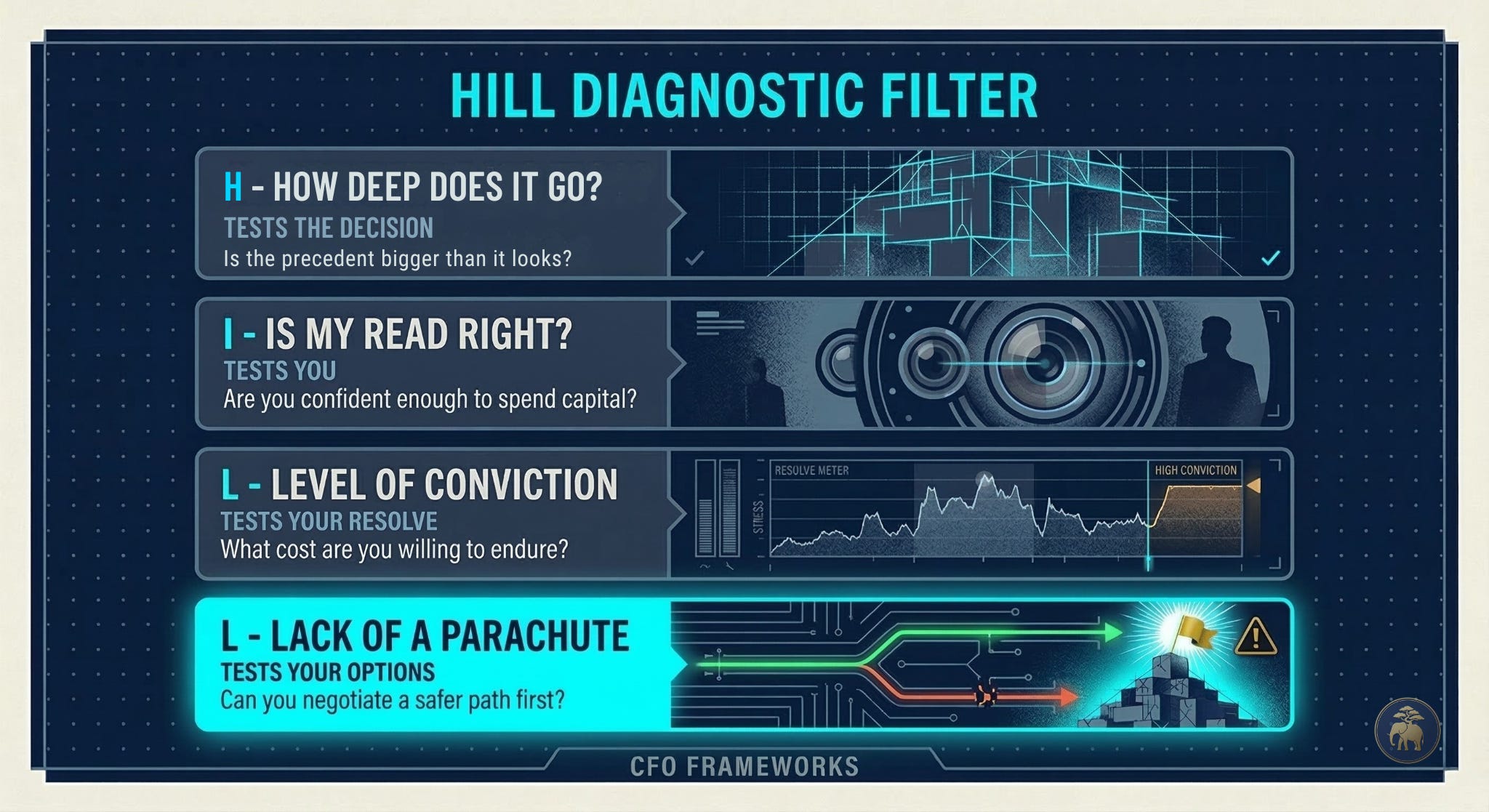
H — How Deep Does It Go? → Tests the decision (is the precedent bigger than it looks?)
I — Is My Read Right? → Tests you (are you confident enough to spend capital on this?)
L — Level of Conviction → Tests your resolve (what cost are you willing to endure?)
L — Lack of a Parachute → Tests your options (can you negotiate a safer path first?)
H — How deep does it go?
If this decision became a permanent, unwritten policy - if every department did the equivalent of this, every quarter, forever - would you still be okay with it?
This is the SWAMP test on steroids. SWAMP asks whether something is worth your voice. The H asks whether something is worth your capital.
The most dangerous decisions don’t look dangerous. They look small.
A marketing team runs a test campaign without ROI guardrails.
A product leader hires a contractor outside the approved headcount process.
A sales team offers a one-time discount that quietly becomes permanent.
The dollar amount is a rounding error, but the precedent isn’t. When unaccountable spend goes unchallenged, every department learns that accountability is optional. When process gets sidestepped and nobody pushes back, the entire planning cycle becomes performative.
Think back to the celery. The variance was immaterial, but an audit process where people don’t report findings fails the extrapolation test immediately.
This test cuts through the noise. You’re not asking, “Is this $50K spend a problem?” You’re asking, “Am I okay with every department running unaccountable test budgets indefinitely?”
If the answer is yes - or even “eh, probably” - this isn’t your hill. You have bigger swamps to cross.
If no, keep going.
I - Is my read right?
Am I sure enough to risk my hard-earned capital?
H tests the decision. I tests you.
It’s tempting to skip this step. You’ve done the extrapolation, you can see where this is heading, and the pattern is obvious. But as I wrote in Confident and Completely Wrong, the most dangerous form of confidence is the kind that doesn’t know it’s wrong. We overvalue the information we have and discount what we can’t see. The gap between how sure we feel and how sure we should be is a chasm you want to avoid falling into.
This is where you apply the BET framework from Slaying the Seven. On a scale of 1 to 10, how confident are you in your read of this situation? And remember: you can’t use seven.
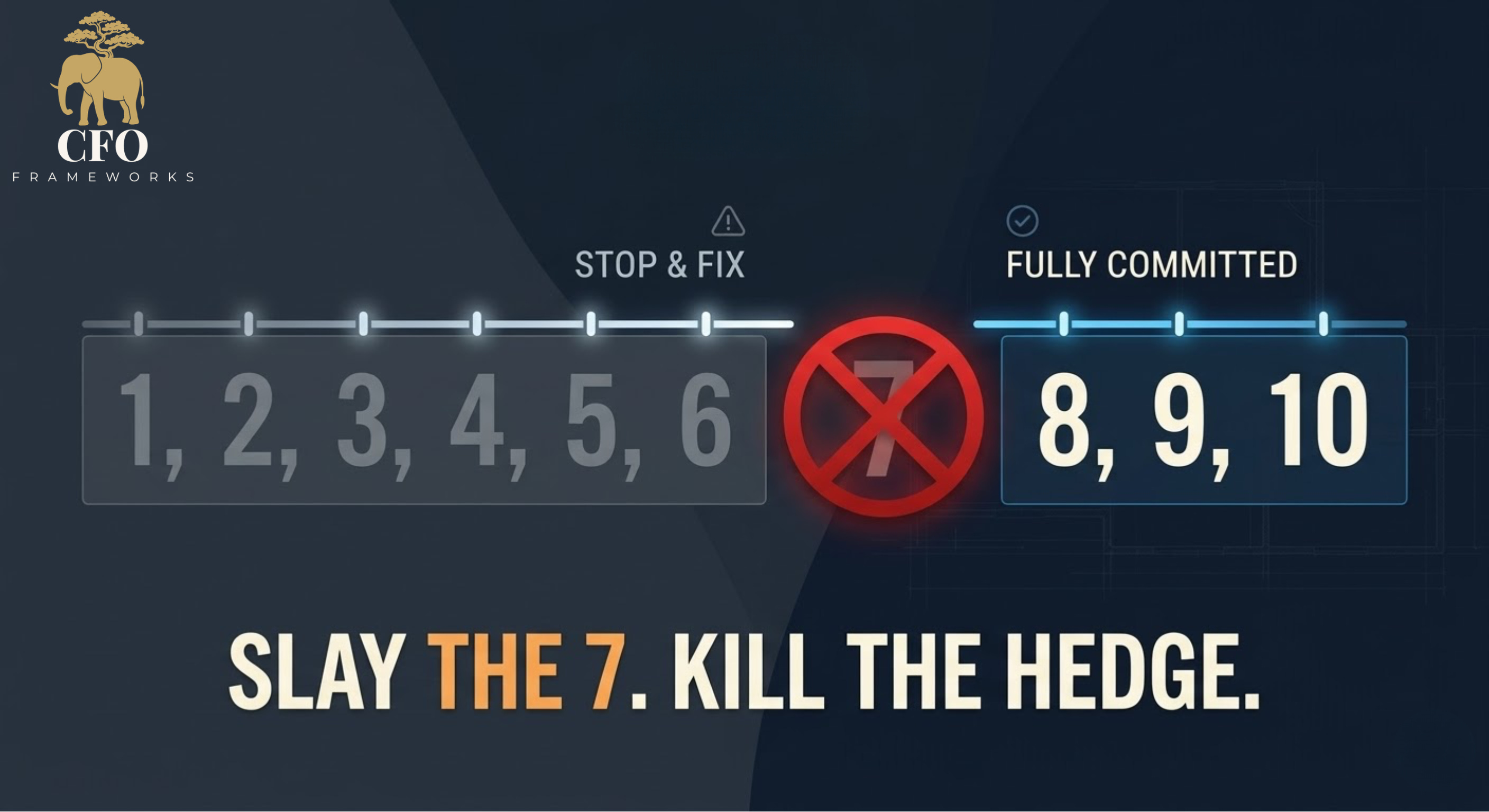
If you’re an 8 or above, you’ve done the work. You’ve sought out the disconfirming evidence, stress-tested your assumptions, and you still believe this is headed somewhere bad. Move to the next letter.
If you’re a 6 or below, stop. Your conviction isn’t strong enough to spend capital on. That doesn’t mean you’re wrong…it means you need more information before you bet everything. Flag the risk, document your concerns, and keep watching. The hill will still be there if your read turns out to be right.
The worst possible outcome isn’t dying on a hill. It’s dying on the wrong hill - and burning the credibility you’ll need when the right one comes along.
L - Level of conviction
What level of misery am I willing to endure to be right about this?
I asked whether you’re right. This L asks whether it matters enough to you personally, because those are not the same thing.
You can be certain a decision is wrong and still decide it’s not worth your career. And that’s okay. Not every correct read deserves your capital.
But when it does - when the stakes match the conviction - you need to know what you’re signing up for. Because dying on a hill isn’t a dramatic speech in a boardroom. It’s a sustained campaign of being the person who won’t let this go. And that has a real cost on you and your reputation.
Bet Your Comfort. You’re willing to be the annoying one in the room for a few weeks. You’ll keep raising it, absorb the eye rolls, and accept being temporarily unpopular. You’re not losing sleep; you’re just losing a little goodwill.
Bet Your Capital. You’re willing to burn real political equity. Relationships will be strained. You’re trading influence on future issues for leverage on this one. This is where your Light Touch disappears, and you become, temporarily, the heavy hand.
Bet Your Seat. You’re willing to lose the job over this. Not because you want to, but because staying silent would compromise something you can’t live with.
The gut check is simple: Does your willingness to endure match the severity of what H and I told you?
If the precedent is org-wide and your read is an 8, but you’re only willing to bet your comfort, you haven’t found your hill. You’ve found something you wish someone else would fight.
If you’re ready to bet your seat over something where the precedent is shallow and your confidence is shaky? That might be ego driving the bus, not conviction.
L - Lack of parachute
Before you sacrifice yourself, propose the tripwire.
Most “hills to die on” dissolve when you reframe them. You don’t need to block the decision. You need to demand a contingency.
“I’ll support this if we agree on the tripwire that tells us it’s not working, and the exit plan if it doesn’t.”
This is the “Yes, And” of high-stakes disagreements. You’re not Dr. No or the blocker - you’re the de-risker. The person who says “yes, with a parachute.”
Think about the marketing spend example. Instead of blocking the test: “Let’s run it. But let’s agree that if we don’t see X return by Q3, we pull the budget and reallocate. And let’s define X now, not when the results are in.”
If the org accepts the tripwire, you don’t need to sacrifice yourself. You’ve built a mechanism to catch the problem early - a circuit breaker that protects the org without requiring you to go to war.
But if they refuse? If the response is “just trust us” or “we’ll evaluate when we get there,” that is the signal. An org that won’t agree to a reasonable off-ramp has already decided the destination. They don’t want anyone pulling the emergency brake.
That’s your hill.
Running up that hill
The framework is designed to be reductive.
Most things fail at H — they’re not that deep when you extrapolate.
Of the survivors, most fail at I — your read isn’t as solid as it feels.
Of what’s left, most fail at the first L — your resolve doesn’t match the cost.
And many of the rest dissolve at the second L when you propose a tripwire.
HILL helps you distinguish when to fight and when not to. It’s the difference between a leader who picks every battle and a leader who picks the right ones.
Think back to that walk-in cooler in Texas. The celery didn’t matter. What mattered was the willingness to say: this is what I found, and I’m not changing it because it’s inconvenient.
Whether you’re a staff auditor pushing back on a senior or a CFO pushing back on a CEO, the question is the same: Is this the one?
All that restraint you’ve been practicing? That’s how you build the capital. The WAIT tests. The SWAMP filters. The light touch. Every time you held back when it wasn’t worth it, you were earning the credibility to be heard when it is.
The goal isn’t to die on hills. The goal is to be the kind of leader whose judgment is so trusted that when you finally say, “This is the one,” the room stops.
So build the capital. And when HILL tells you it’s time - spend it. Don’t let that one go.
Before You Go
If you’re reading this, you’re either part of the early crew who took a chance on an unknown newsletter or you’re new, and someone you trust sent this your way. Either way, thank you. I appreciate all of your feedback and support.
If you found value in this post, the best way to support this work is to share it with someone who’s dealing with the same challenges. Send them the post, or just send them to cfoframeworks.com to subscribe.