


It started raining here in Phoenix the other day - a minor miracle.
My daughter, who is four, was thrilled. My son, who is one, was ambivalent. And my wife, whose age will remain undisclosed, was confused.
That’s weird. The weather app said a 30% chance of rain, but I didn’t think it would actually happen. This is the first time it’s ever been right.
- My lovely, very smart, anonymously aged wife
Weather forecasts, like any forecast, aren’t particularly intuitive. We see “30% chance of rain” and conflate it with “not going to happen” rather than “if we had ten days with these exact conditions, it would rain on three of them.”
Thinking probabilistically requires us to imagine alternative timelines, a difficult feat in and of itself. But when we have to commit to a forecast, it becomes even more difficult because, at the end of the day, we either meet the objective or we miss. Just look at how wildly inconsistent we are in interpreting probabilistic language!

The gap between what people say and what they mean is where forecasts go to die. But the good news is that we can coach those around us to close that gap. This not only helps us get better inputs into our outlook for the company, but it also helps them see what’s around the corner and proactively react to it!
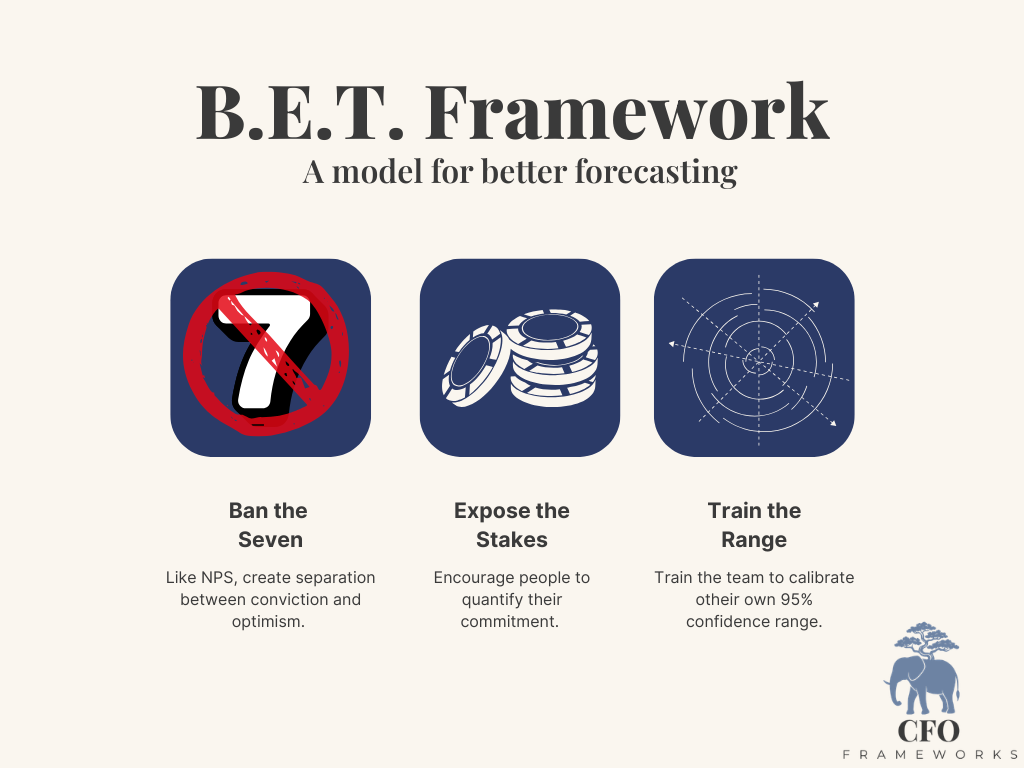
Regardless of the forecasting maturity you’re dealing with, I have a solution that will help you. Below is the B.E.T Framework for better probabilistic thinking.
B. Ban the seven
We should all fear the number seven. (And, yes, it was physically painful not to make a “Why was six afraid of seven?” joke here.)
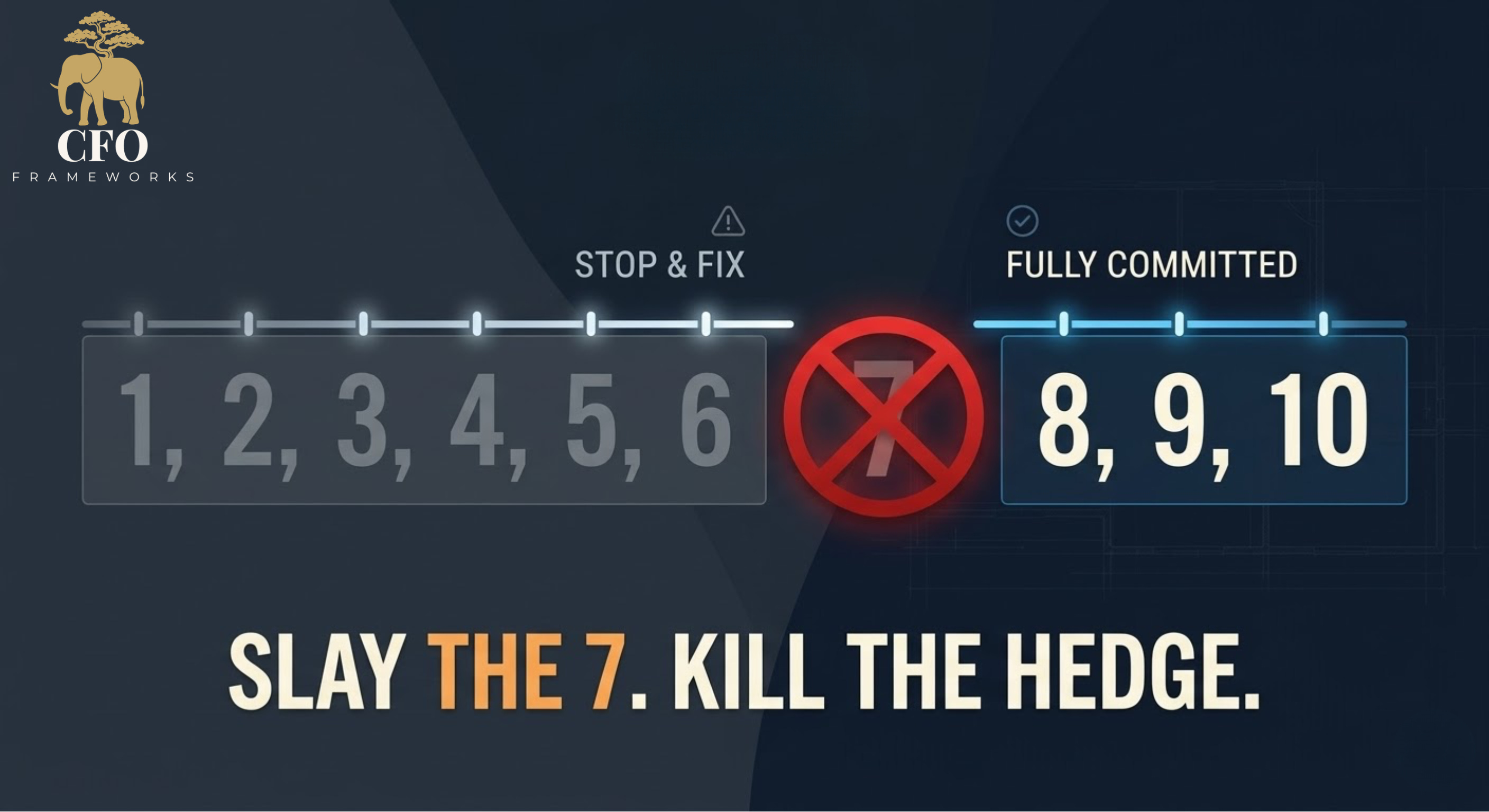
For beginners, a good basic framework for forecasting is asking someone to express their confidence on a scale of 1 to 10, with 1 being never gonna happen, and 10 being guaranteed.
BUT, and this is a big but, when people are uncertain, they’ll use seven as a hedge. It’s high enough to look like you’re trying, but low enough to let them opt out if it fails.
My old COO was relentless about this. During budget sign-offs, he’d go around the room and ask everyone on the team - not just the VPs - how confident they were on a scale of 1-10, and you could not use 7.
This forced you into a binary. You’re either:
8 or above - effectively fully committed, or
6 or below - implicitly flagging a risk that you’ll have to make explicit
If you said 8-10, you were on the hook. If you were missing your commitments in April, you would be reminded about your confidence score if you tried to insinuate that the goal was really more of a stretch goal.
If you said six or below, the meeting stopped until you and your team identified what data point or resource was needed to get you to an 8.
Kill the seven, and you kill the safety of the hedge.
One caveat: none of this works without psychological safety. If people fear punishment for a low confidence score, they’ll just game the system with eights. The goal is honest signal, not performative certainty. Build the trust first, then build the muscle.
E. Expose the stakes
In Thinking in Bets, Annie Duke argues that the most honest question in the world is: "Wanna bet?" As soon as you put a price on an opinion, the brain shifts from "selling" to "processing."
If you’ve graduated from binary, but the team is still struggling with distinguishing a 75% confident floor vs a 95% confidence floor, you can start to dip your toes into probabilistic thinking by getting your team to make these kinds of bets.
I saw this play out firsthand when a colleague of mine ran his forecast reviews with a payscale pinned to the wall.
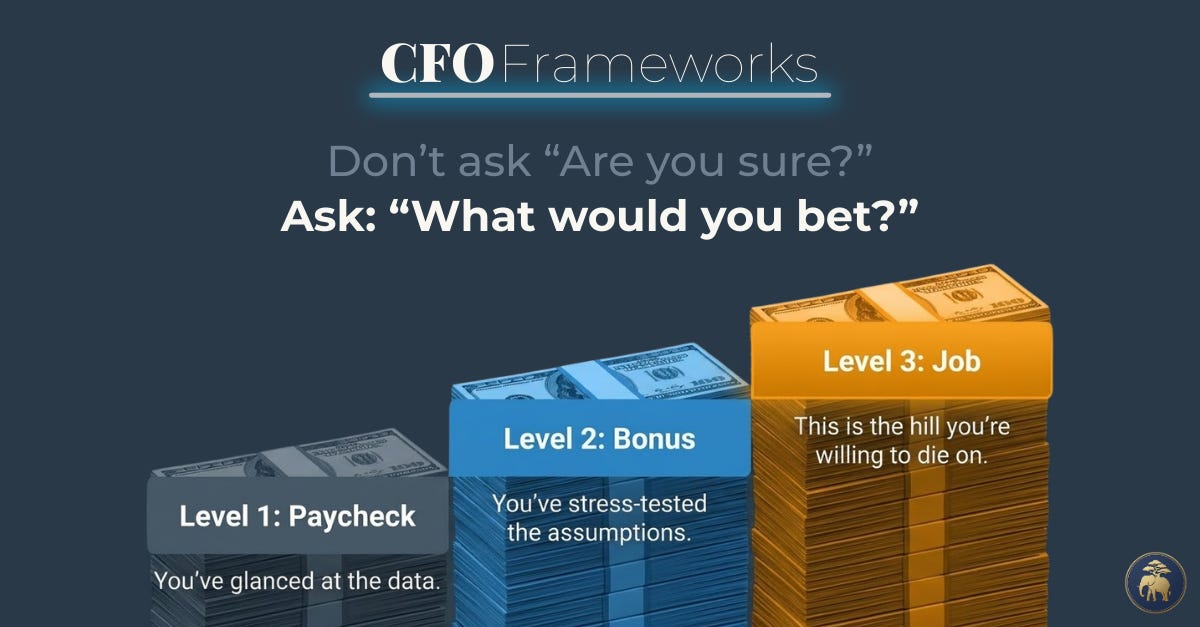
Bet your paycheck (Level 1): You’re pretty sure.
Bet your bonus (Level 2): You’re confident.
Bet your job (Level 3): You’re certain. This is the hill you’re willing to die on.
One quarter, a sales leader said he’d “bet his bonus” on hitting a stretch pipeline target. Two months later, when the pipe was soft, my colleague pulled up the bet. The conversation wasn’t adversarial – it was clarifying. The leader had to articulate what had changed, not just wave his hands at “market conditions.” That’s the power of the bet: it creates a reference point that makes revisionism harder.
When you ask a sales leader, "Would you bet your bonus on that Q4 revenue forecast?", the posture of the conversation changes instantly. A bonus payout is far more tangible than a percentage, and because it’s relative to the individual, you can get a sense of their confidence based on how much they’re willing to commit.
T. Train the range
If your team is ready for more nuance than betting on portions of their take-home pay, the final step is to teach people what “95% confidence” actually looks like.
Most people are wildly overconfident in their own uncertainty. They think “95% sure” means “I’m really sure,” but it actually means that if you make 20 predictions, you should only be wrong once.
To train this muscle, run a Range-Finder Drill.
Ask your team to provide a range (a lower and upper bound) for 20 items they couldn’t possibly know exactly, like the length of the Nile River or the year Harvard was founded.
If your team is properly calibrated, they should get 19 out of 20 right. If they only get 10 right, they’ve just proven their “confidence” is a guess.
Try one right now: What year was the first iPhone released?
If you said your 95% confidence range was 2005–2009, you’d be right – it was 2007. But if you said 2006–2008, that’s a tighter range that reflects more confidence than most people actually have.
If you need some examples, you can check out the calibration questions in How to Measure Anything, which I’ve excerpted here.
This drill builds the mental muscle of setting wide enough ranges to account for the things they don’t know. And, in turn, when you’ve seen them develop this muscle, you can have confidence in their 95% confidence outcome.
Going all in
Precision is a muscle you have to build, not an innate trait.
If you want your team to be better forecasters, you have to stop letting them hide in the middle ground.
When this works – when your team has killed the hedge, learned to put skin in the game, and calibrated their ranges – you stop getting hopes dressed up as commitments. You start getting leverage where someone says, “I’m a six on this,” and everyone in the room knows exactly what that means and what to do about it.
If you don’t teach your team how to bet, don’t be surprised when your forecast leaves you standing in the rain.
Thanks for reading CFO Frameworks! Subscribe for free to receive new posts and support my work, and leave me a comment to let me know what you think.