


There’s a line from Bluey, of all places, that I can’t stop thinking about. In Dance Mode, Chili asks Bingo a question after watching her repeatedly agree to things she clearly doesn't want to do:
Does your outside voice say yes when your inside voice really means no?
It’s a profound question for a kids’ show. One we should ask each other more often when making consequential decisions.
We all know what an outside yes sounds like - some version of “sounds good,” “we’ll make it happen,” or, God forbid, “you’re the boss!” But if we stop there, we allow this affirmative theater to mask a very expensive silent no.
A decision doesn't need unanimous agreement, but it does need genuine commitment from the people responsible for executing it. A yes you have to verify later is a maybe. Maybes don't get acted on.
The good news is silent no’s aren’t random - they can be traced to a few specific causes. Once you know which no you’re dealing with, you can do something about it - either the yes becomes real, or you surface the no fast enough to make a better decision instead.
The week nothing happened
We spent months circling the same idea in every leadership meeting: we needed to move upmarket. It came up constantly - in strategy sessions, in operating reviews, in the hallways. Everyone agreed we had to do it.
And yet, if you looked at what was actually happening day to day, nothing had changed.
In the weekly cross-functional opmech, we got specific: Marketing would deprioritize companies below our ICP and shift that spend toward enterprise. Clear decision, clear rationale, clear next steps.
One week later, we inquired how that up-market shift was going. The head of demand gen suggested we set up a separate meeting to discuss trade-offs before we made such a big change to our spend mix.
A heavy silence fell as the room processed her words. The decision had already been made the week before, in that same meeting, with her in attendance! But in the intervening week, her inside voice won. In her mind, there were still unresolved questions - a follow-up conversation she was waiting for that no one else knew needed to happen.
And she may have been right. The trade-offs may not have been fully thought through, but that wasn't really the problem. The problem was that the room believed a decision had been made, while she was privately still deciding whether to make it.
For an entire week, two conflicting realities coexisted. The CEO and leadership team thought the org was finally moving upmarket, while the Marketing leader waited to revisit unresolved questions before fully committing to what she considered a hasty decision.
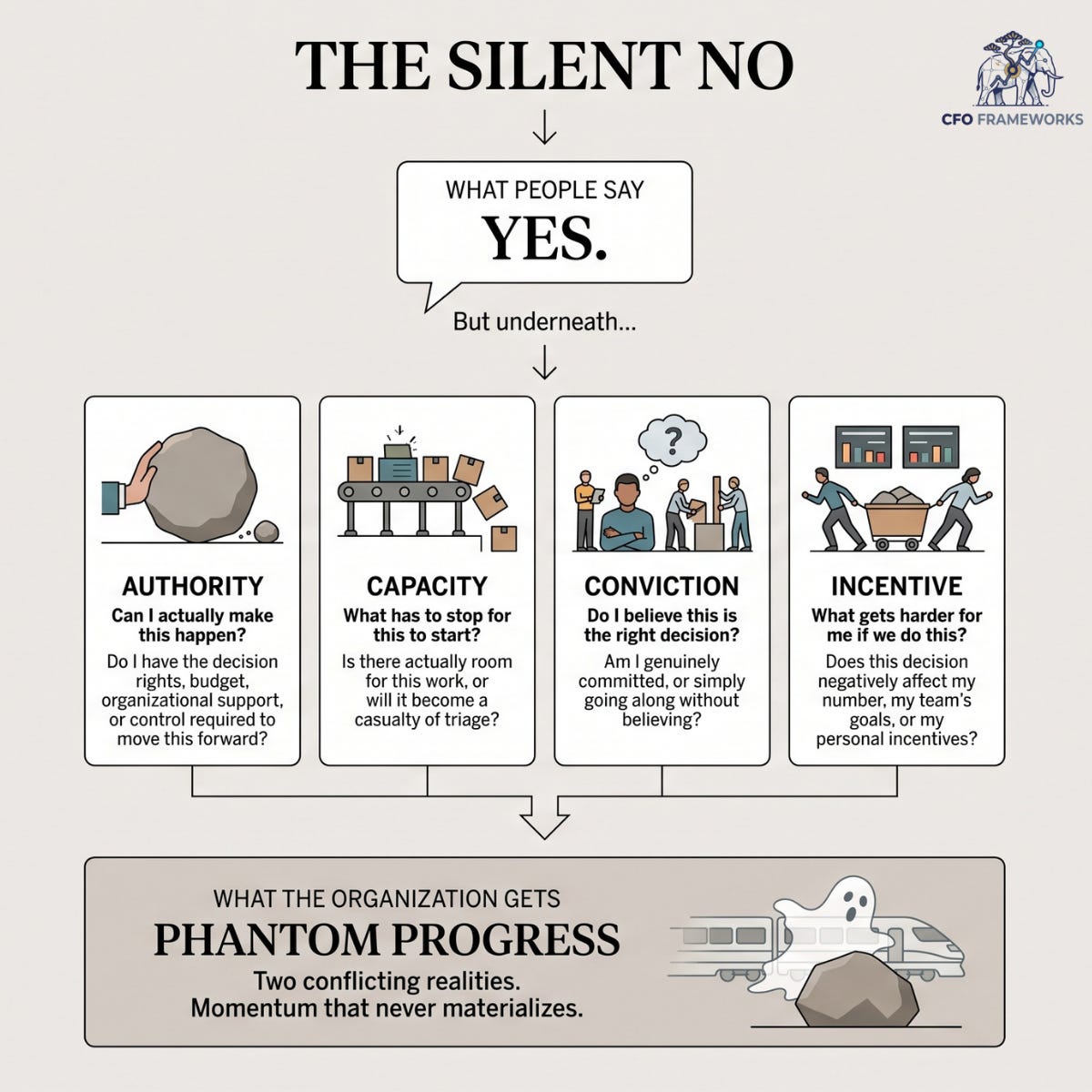
That's the cost of a silent no: phantom progress. Everyone believes the ball is moving because everyone agreed it should. The room needed healthy conflict in that first meeting, while there was still time to resolve it. Instead, it got silence, and nobody noticed the ball wasn't moving until someone checked a week later.
Affirmative theater
In my experience, the inside voice stays quiet for one of four reasons.
Authority. The individual agrees, but they don’t control what you need moved (e.g., budget, headcount, priorities). The yes is sincere, but it isn’t theirs to give.
Capacity. They agree - genuinely - but their resources are dedicated to something else. The yes is sincere, but it’s a casualty of triage.
Conviction. This one's different from the other three. The yes isn't sincere; it's a stall. They don't actually agree, but they're not prepared to fight the decision in the room. So they go along without ever really committing, hoping the idea loses momentum before they have to act.
Incentive. The decision is correct for the company and costly for them personally. The yes is sincere, but they haven’t gotten comfortable with how the decision impacts their number, their team’s target, or their next review.
The internal calculus varies wildly, which is why “everyone good?” is insufficient as a closing question. Asking for affirmation is a great way to get a room full of people to say “yes” when they mean “no” because it asks for a performance rather than a position.
The organization needs disagreement before the decision, and commitment after it. What it can't survive for long is the opposite: agreement in the room and disagreement in the work.
Surface the tension
Surfacing silent no’s takes effort. Simply asking if anyone’s outside voice doesn’t match their inside voice will not suffice.
Surfacing dissent means making commitment individual. Don't ask the room whether everyone is good. Ask each person what they think.
Go around the table and make silence cost something.
Four questions help unearth which challenge(s) you’re facing:
Authority: Do you have what you need to make this happen?
Capacity: What has to stop for this to start?
Conviction: Do you actually believe this is the right decision?
Incentive: What gets harder for you if we do this?
If there’s hesitation, you can leverage the Slaying the Seven concept (confidence is expressed on a scale of 1-10, but they can’t use 7) to quantify the level of concern.
Once the objection is on the table, the meeting has two legitimate outcomes:
The yes becomes real. If it's an authority gap, get the actual decision-maker on record before you leave. If it's capacity, resource it or cut something else to make room. If it's incentive, change the target or call out the trade-off, so nobody pretends it doesn't exist.
You make a different decision. The objection is valid. The trade-off wasn't fully understood, and once you say it out loud, the room changes its mind too. That's a productive meeting when you find out in the room, not a week later.
What you can’t afford is the third option: everyone nods, everyone leaves, and a week later, nothing has moved.
The goal is to surface the disagreement while there's still time to act on it, and to know, once the decision is made, that the people executing it aren't still saying no on the inside.
Thanks for reading CFO Frameworks! Subscribe for free to receive new posts and support my work, and leave me a comment to let me know what you think.