


It has never been easier for someone to access your attention.
The calendar invite is the cleanest example. Scheduling used to require effort: finding a mutual window, navigating through an assistant, making a case for why the meeting was worth everyone’s time.
That friction - that inefficiency - was a filter. The meeting had to justify itself before it ever happened. Then digital calendars made it nearly frictionless to drop time on anyone’s schedule, and meeting volume exploded. It’s not that people had more to discuss, but that the cost of calling a meeting had collapsed. The efficiency gain from scheduling was fully offset by the increase in meetings. Most people came out the other side busier, not freer.
Slack was supposed to fix the communication problem that survived the calendar — and in many ways, it did. It promised 80% less email, and largely delivered. What it created instead was Slack Holes: ideas, decisions, and analyses dropped into channels with near-zero friction and even less accountability.
Great ideas that are never followed up on. Recommendations buried under 12 other threads. As the cost to drop something into the discourse collapsed, so did the implicit commitment to stand behind it.
Frictionless input, it turns out, tends to produce ownerless output.
The pattern holds across every technology step-change: as the barrier to produce something lowers, volume expands to fill the available capacity and, ultimately, spills over into the attention of everyone downstream. The production burden shifts downstream to those responsible for evaluating what comes through and those who must own what gets acted on.
AI in finance is this pattern at a scale and speed the calendar and the inbox never approached. And the stakes are considerably higher than a crowded meeting schedule.
The squeeze
Finance leaders are getting squeezed from both ends right now. Growth is harder to come by due to macro headwinds, longer sales cycles, and historic levels of uncertainty. Boards want more with less. Headcount is flat or shrinking. And in the middle of all of this, AI arrives looking like the answer to every constraint simultaneously: faster analysis, leaner teams, more output per dollar of labor.
The efficiency gains are real. The cost-to-produce anything - a pricing model, a headcount sensitivity, a slick dashboard - has collapsed to near zero. What used to require a scoped project and a senior analyst now requires a prompt and a few minutes. That’s powerful, and the finance leaders who figure out how to harness it will have a meaningful advantage.
But there’s a version of this story in which we conflate the cost of production with the value of what’s produced. The level of effort no longer correlates with results, and nobody notices until it’s already too late.
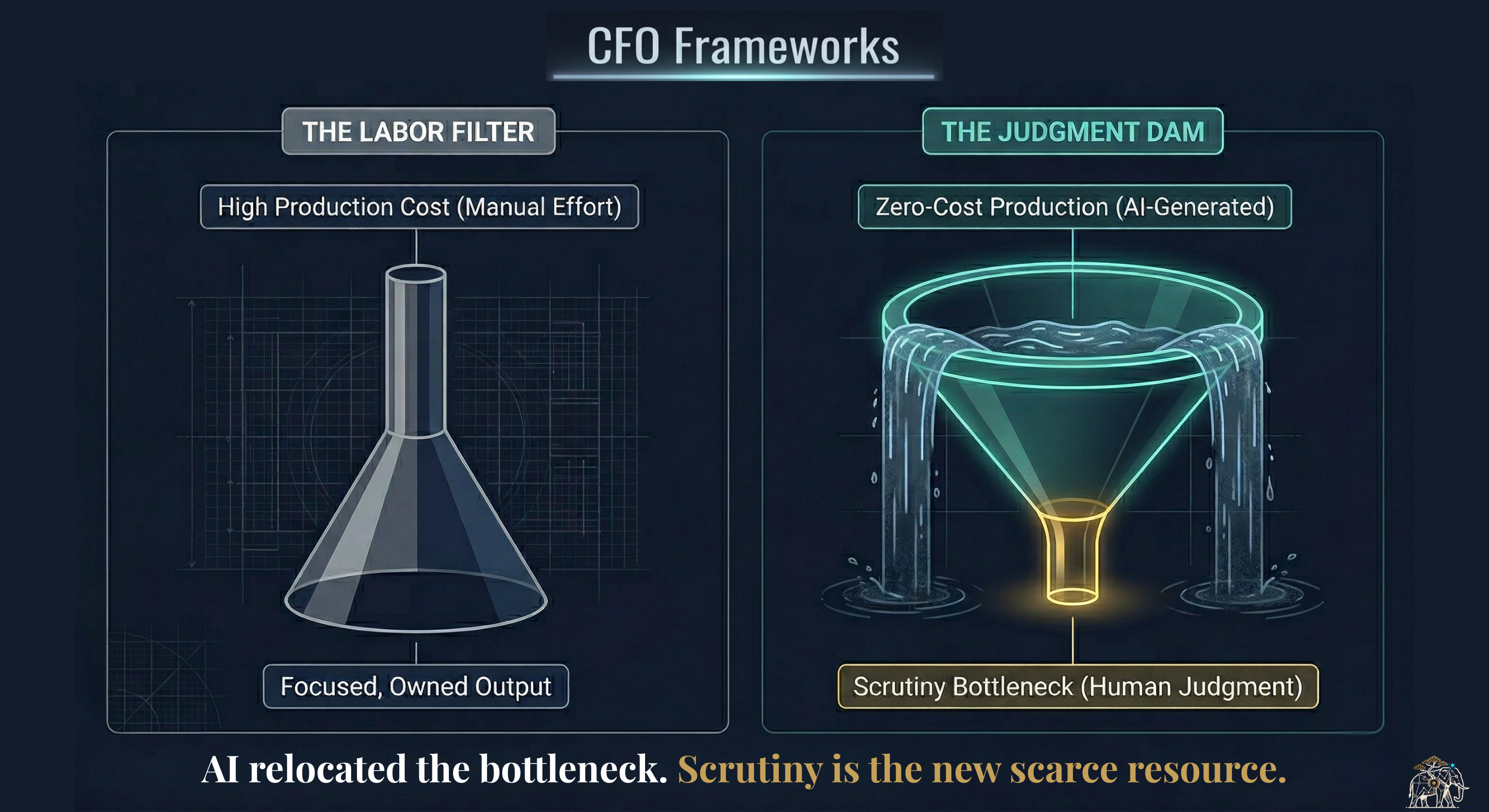
Friction was the filter
Before AI, the cost to produce analysis was itself a materiality test. If a question wasn’t worth 20 hours of analyst time, it didn’t get answered. This perceived bureaucracy was a functional filter, baked invisibly into the cost structure of every finance team. The natural constraints on what could be produced and within what timeframe created space for conviction. If someone commissioned an analysis, they were implicitly staking something on the outcome.
AI eliminated that filter. And when the cost of production drops, so does the barrier to entry. Demand doesn’t stay flat - it expands to fill the available capacity, and then some. More analyses get commissioned. More functions self-serve work that used to require a specialist. More outputs get circulated. The volume compounds - and unlike the crowded inbox, we haven’t created the scaffolding to discern valuable communication from spam.
Everything arrives dressed as insight, co-authored by no one in particular, owned by no one at all.
As the dam breaks, unprepared teams will drown in work devoid of the judgment and ownership required for anything useful to come of it.
The constraint didn’t disappear. It moved.
Scrutiny is the new scarce resource. Most finance leaders haven't priced that in yet.
The constraint used to live upstream: who has the skill and capacity to build this? Now it lives downstream: who has the judgment and capacity to scrutinize it, and who is willing to put their name on the conclusion?
That’s a fundamentally different problem. And it’s more expensive than it looks.
Production is cheap and scalable. Scrutiny is neither. It requires a qualified human, genuine attention, and enough context to know not just whether the analysis is correct, but whether it was even the right question to ask in the first place. You can’t run that in parallel at low cost. You can’t automate your way out of it without creating the very problem you were trying to solve.
The finance team isn’t the only source of this work, either. Every function in the business now has access to tools that would have required a data science background two years ago. The volume of analytical output landing on the discernment layer is growing from every direction simultaneously, and most of it bypasses any meaningful review before reaching a leadership deck.
The Slack hole taught us that frictionless input creates ownerless output. AI analysis is a problem at a scale and with consequences that Slack has never approached.
The decision velocity trap
Finance leaders have always been valued for the quality of decisions they drive - not the volume of analysis they commission. That distinction has never mattered more than it does right now.
AI dramatically increases the speed at which analysis reaches decision-makers. What it doesn’t do is improve the quality of the judgment applied to it, or install any sense of ownership in the person who produced it. If your goal as a finance leader is to drive decision velocity, you need to re-establish friction in front of the flood of unscrutinized, unowned output that will overwhelm the organization’s ability to decide. If your organization spends more time evaluating the credibility of what’s in front of them than acting on it, you are suffering from drag at your most critical (and expensive) juncture.
The irony is sharp. The tool designed to help you do more with less can just as easily saddle your organization with more noise than it had before. If the judgment layer doesn’t keep pace with the production layer, and if nobody is accountable for what crosses the line from analysis into action, the team will struggle with the disconnect between the volume of work and the dearth of action.
Where the leverage actually is
Don’t get me wrong - I am emphatically in favor of AI. Use it. Aggressively. The finance leaders who hesitate here will fall behind, and they should. The efficiency gains are real, the capability uplift is real, and there is a genuine competitive advantage available to teams that harness this well.
But the winners in this race will be those who are methodical. They’ll be the ones who built the discernment layer to replace what was lost - who treated scrutiny as a scarce resource, allocated it deliberately, and insisted that every piece of analysis that drives a decision has a human owner prepared to stand behind it.
The water is rising. That’s not a reason to step back from the bank. It’s a reason to build something before you wade in.
Next up — Part 2: Build the Dam
The intake framework won't hold, and the accountability train isn't coming. So what do you actually do? We'll get into the practical architecture - how to treat scrutiny as a scarce resource, what ownership looks like in an AI-enabled finance org, and the one standard that's harder to route around than any process gate.