
I first explored this idea when there were 50 subscribers. A year later, the argument holds up better than I expected, so I've tightened it up for those of you who missed it the first time.
"We need more."
When organizations struggle, the obvious solution is to add something.
More people to handle the load. More features to stay competitive. More processes to prevent mistakes. More meetings to stay aligned.
This thinking is intuitive, but often wrong. Addition creates complexity. And complexity creates new opportunities for things to go wrong, often in the very area we were trying to improve.
Said another way: the more we add to address our problems, the more problems we create to fix.
Thought experiment
In a recent leadership workshop, I presented this challenge:

Imagine you are a manager at this Circle K location and have been tapped to address the escalating number of robberies. Like most convenience stores, your store holds cash on hand, making it a target for petty criminals, and the crime rate is hurting your employees, customers, and bottom line. Also, like most convenience stores, margins are thin, so you don’t have unlimited capital to solve the issue.
How would you address this problem?
Most of the suggestions fall into one of three buckets:
Expensive deterrents (e.g., higher security monitoring, on-site security),
Inexpensive deterrents (e.g., firearm under the register, local police presence), or
Damage control (e.g., employee training, HD cameras to catch perpetrators)
You may have noticed a theme - they all add something. Added security. Added police presence. Added training.
There’s nothing inherently wrong with these ideas, but none of them feel quite right. We’re operating in a constrained environment, yet we can’t help but add something to reduce the problem.
Why not remove something? Take a look at that picture of the storefront again. Did you notice that advertisements are obscuring the windows? Gee, I wonder why criminals see your store as an easy target.
This may sound like a silly example, but it’s based on a program launched by the police in Canada called Clear Zone. The basic premise providing visibility directly into a store and the front counter from the street deters criminals because they're more likely to get caught. Launched in 2013, it reduced robberies by 18% and, most importantly, it cost the stores nothing.

The owner of this Circle K removed posters from the far left window to see the cash register from the street.

Addition bias
Reducing our pain by adding more is a cognitive bias.
Behavioral scientist Leidy Klotz designed a series of experiments with lego structures to showcase how we often overlook removing something to improve it.

In one study published in Nature, researchers gave participants a challenge: modify a sandwich-like structure made from Legos (like the one above) so it could hold a brick above the head of a Stormtrooper figurine without collapsing.
Participants were given a dollar for successfully completing the task, but there was a catch: every LEGO piece they added cost ten cents.
The best solution was to remove the single block forming the thin part of the column. The top panel can then attach to the larger section of the column, stabilizing the structure while still leaving enough clearance to avoid the storm trooper getting squashed by the masonry brick.
Subtracting one block was the fastest way to solve the problem, and it was the only solution that allowed participants to earn the full dollar.
And yet participants were still more likely to add than subtract! The challenge was framed like an addition problem: The structure needed to be stronger, so what could you add?
Only when prompted to consider subtraction did anyone consider removing a brick to stabilize the structure. Otherwise, people focused on adding bricks despite the cost.
We do the same thing at work.
A process isn’t working, so we add a step. A team is overloaded, so we add headcount. A report isn’t giving us enough information, so we add another metric. A meeting isn’t producing the right outcome, so we add another meeting.
Each addition may make sense in isolation. But every addition also introduces new complexity, new dependencies, and new opportunities for something to go wrong.
We rarely think of subtraction as a solution unless we’re prompted to, because we equate addition with progress and subtraction with loss. Even when subtraction is clearly better - cheaper, simpler, more elegant - our instinct is to build up rather than pare down.
Like the Lego participants, we neglect the cost of addition because we’re so focused on the problem at hand. We don’t just add a solution; we add everything that comes with the solution.
The Hidden Costs of Addition
Over the past few years, organizations have become adept at scrutinizing spending, improving margins, and doing more with less. These are objectively good habits, but they create a blind spot: we became very good at asking what something costs without asking what it will create.
Every new process, system, role, or feature creates complexity that has to be managed. Every new meeting, report, or initiative consumes scarce attention. And every new layer creates another opportunity for something to break.
More requires more.
Not just more money, but more coordination, more maintenance, more management, and more attention.
Worse, the thing we add to solve one problem can create another. A new process creates a problem, so we add a control. The control creates friction, so we add another workaround. The workaround creates confusion, so we add another layer of oversight.
Pretty soon, we're swallowing the bird to catch the spider we previously swallowed to catch the fly.
This is how organizational complexity accumulates. Each addition is a reasonable response to the problem immediately in front of us. But each one changes the system and creates new opportunities for things to go wrong.
Eventually, we’re no longer solving the original problem. We’re managing the problems our solutions created.
To be clear: these additions are rarely irrational. A new control can prevent errors. A new initiative can create momentum. A new hire can add capacity.
They’re also easy to celebrate. Doing more is a good cover for when nothing is going well (see The Dangers of Playing it Safe). Sure, times are tough, but look at the effort...or so the thinking goes. Ultimately, these strategies delay the inevitable, but that doesn’t negate the tactic's appeal.
The key to all of this is to remember that subtraction isn’t about doing more with less but removing what doesn’t meaningfully move you forward. Paradoxically, only by removing things that would otherwise diffuse our efforts can we ultimately end up with more.
When things aren’t adding up, start subtracting.
How to Add Subtraction to Your Toolbox
The goal isn’t to stop adding - sometimes addition is the right answer. Instead, we want to stop treating addition as the only answer.
Make It Explicit
Change the questions
The hardest part is identifying subtraction as an option in the first place. One way to break the addition bias is to change the questions we ask:
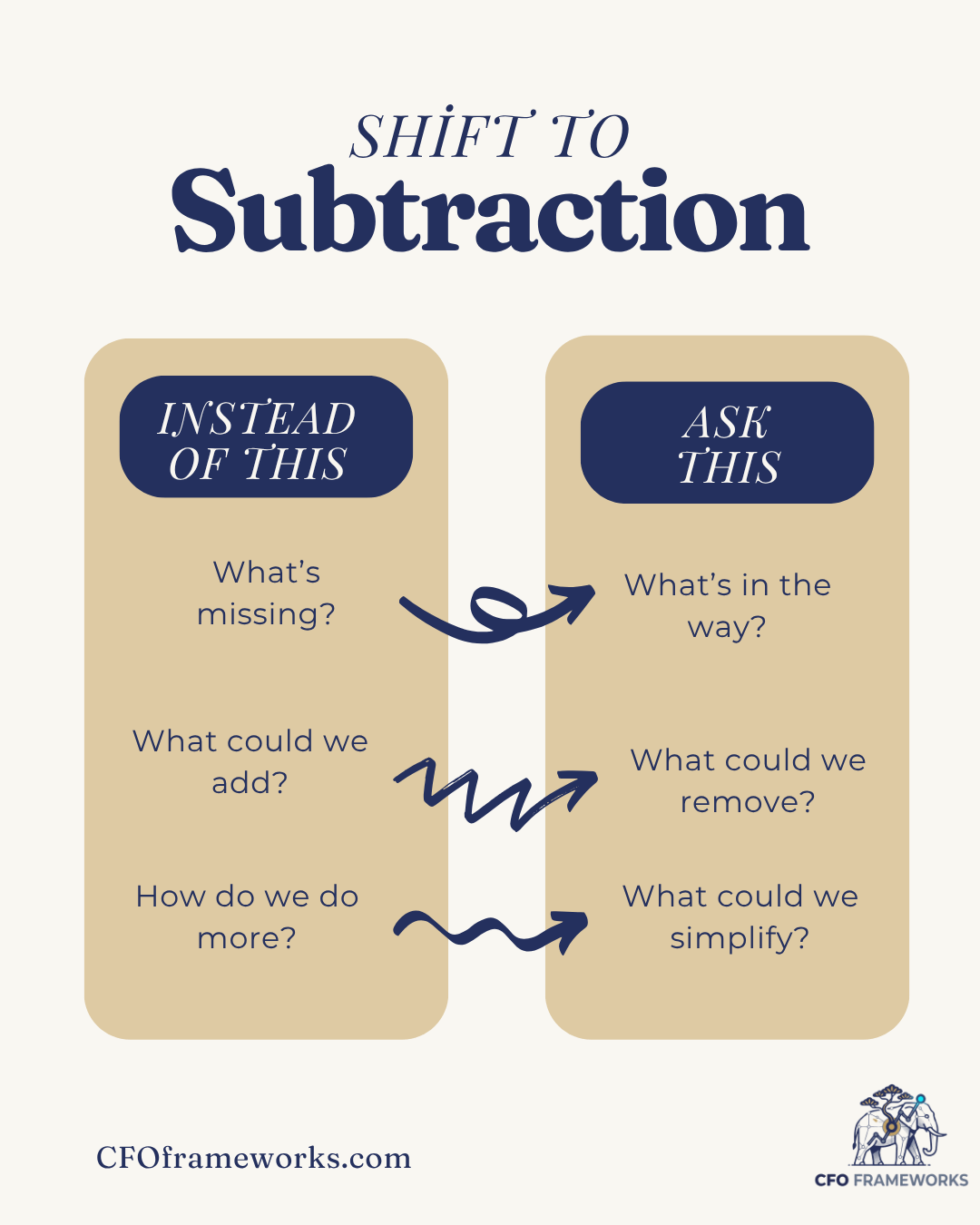
These questions prompt us to explicitly consider subtraction as part of the conversation. Once you start asking them, you’ll be surprised how often the best solution is to take something away.
Make It a Practice
Change how you diagnose problems
Subtraction becomes easier when you train yourself to look for it.
Rather than seeing every challenge as a new problem that needs new resources, recognize it’s part of a system whose components may need to be retuned.
Start by understanding how the system is failing. Is something actually missing, or have the things already in place been poorly connected, redundant, or unnecessarily complex?
Maybe two meetings should become one so the right people can connect the dots. Maybe two reports each tell half the story, when together they'd tell the whole thing. Maybe an approval step meant to prevent errors has created a bottleneck elsewhere in the process.
The goal isn’t simply to remove things. It’s to make the system work better with what you already have.
Make It Visible
Change what you reward
Subtraction is hard to celebrate because its result is often an absence.
A new hire, initiative, feature, or system is a tangible sign of progress. But what happens when we eliminate a meeting? Or remove a redundant approval step? Or shut down an underperforming initiative?
At best, nothing other than sighs of relief. And that’s a particular challenge for the teams and individuals looking for proof of improvement. We can measure what we’ve added, but it’s far harder to take stock of what we've let go of.
If we want the organization to embrace subtraction as a habit, we need to change that.
Celebrate the team that simplifies the process. Recognize the leader who kills an initiative that isn’t working. Tell the story at the All Hands about someone who was able to expand their scope by doing less.
If addition is what we reward, addition is what we’ll get.
More Requires More
Organizations rarely become complicated because someone deliberately decided to make them so. They become complicated one reasonable addition at a time.
A new process here. A new report there. Another meeting. Another approval. Another system. Another person.
Each decision makes sense on its own until, one day, we’re spending more time managing the solutions than solving the problems.
The goal isn't to eliminate everything that isn't essential. Organizations need people, processes, systems, and controls. The goal is to be more deliberate about what we add and intentional about the complexity, obligations, and failure points those additions create.
This isn't about asking the organization to do more with less. It's about recognizing when more actually requires more, and whether the organization needs that additional complexity in the first place.
If we can train ourselves to see what doesn’t belong and have the courage to remove it, we signal to those around us that we value velocity and clarity more than complexity and architecture.
This idea kept resurfacing. It came back as "limit concurrent work" in Upstream or Underwater. It came back again as the whole engine behind A Light Touch. Apparently I can't stop believing it.
When things aren’t adding up, start subtracting.